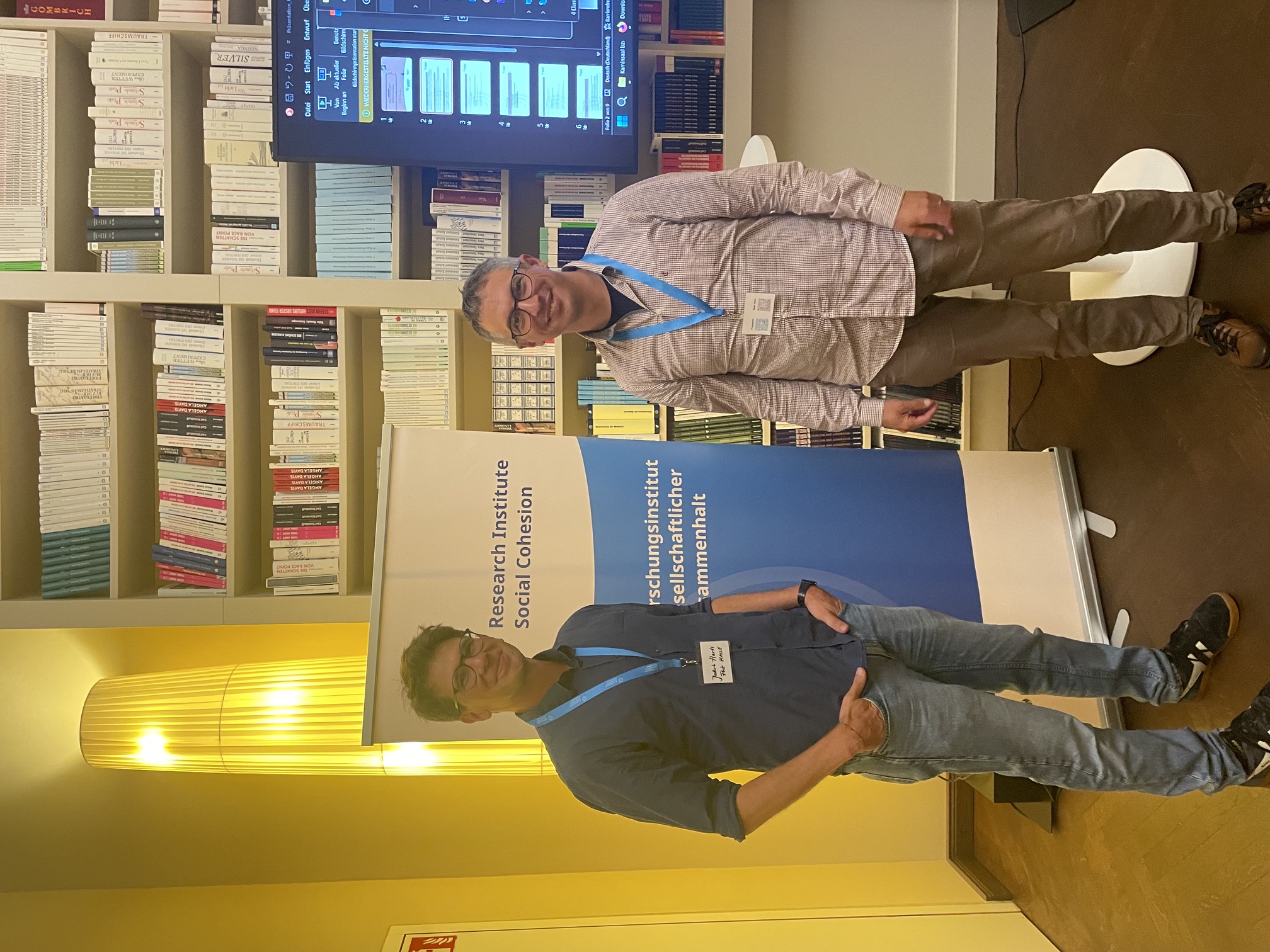
What can we learn about social cohesion by comparing Germany and Poland? Jakob Hartl and Tomasz Piróg are collaborating to examine how cohesion develops at the local level. Their collaboration initially took them to Chrzanów, Poland—and has since evolved into a larger comparative research project. In this interview, Hartl and Piróg explain how the collaboration began, what connects Chrzanów to Merseburg and Gladbeck, and what questions the new project is exploring.
Your collaboration goes back to the RISC Regional Panel in Halle. How did you first come to work together – and when did the idea emerge to broaden the focus on local social cohesion from Germany to Poland?
Tomasz Piróg: The proposal for collaboration came from Prof. Reinhold Sackmann, who was in Kraków as a visiting professor before RISC was being established. I knew Prof. Sackmann from a previous stay in Germany. In 2012, I was a DAAD fellow in Halle, and he was my scholarship advisor. We had met two years earlier, when I visited Halle with a group of Polish students as part of a study tour of Germany.
Jakob Hartl: Going back to the late Reinhard Kreckel, Sociology in Halle was since the 1990s concerned with post-communist transformation: societal processes and sociality, the way we live in, experience, and perceive society are contingent on both historical path dependencies and sudden shocks, like living on either side of the iron curtain for decades and then being suddenly exposed to a new economic, political and thus ultimately social regime. Reinhold Sackmann also worked on post-communist transformation and later was a visiting professor at AGH Krakow, as Tomasz mentioned. Thus, I think he always had the idea of expanding the comparative design of the Regional Panel to Poland, and thus we applied for funding from the Deutsch-Polnische Wissenschaftsstiftung and also from the FGZ Datenfonds to implement, firstly, a pilot study.
In your first joint pilot study, you examined social cohesion in the Polish town of Chrzanów. What did you find there – and were there any findings that surprised you?
Jakob Hartl: For the pilot study, Tomasz and his colleagues suggested the middle-sized town of Chrzanów, which we found super interesting, since it shares various similarities with two of our mid-sized towns, Merseburg in Saxony-Anhalt and Gladbeck in Ruhrpott: all three of them experience and are troubled by deindustrialisation.
Tomasz Piróg: Our study revealed various patterns of social cohesion in the neighborhoods of Chrzanów. What was surprising was that the problem areas were precisely those that the city administration considered to be in need of revitalization.
What can we learn about social cohesion by comparing Germany and Poland? Which similarities and differences stood out to you in particular?
Tomasz Piróg: It is still too early to identify similarities and differences. We are currently in the process of analyzing and preliminarily comparing the data. The first publications are scheduled for next year.
Jakob Hartl: Something which puzzled me, but which is also revealing, is the limited applicability of concepts and conceptualisations and thus operationalisations of them in different national, historical, cultural, political, and social contexts. This is also an important lesson for comparative approaches to East and West Germany: too often we apply instruments tested solely in West German contexts on East Germany.
What began as an initial collaboration has since developed into a longer-term German-Polish research partnership. Tomasz, you are currently continuing this work in a new comparative research project. Which questions have remained unanswered so far – and what are you hoping to find out now?
Tomasz Piróg: As part of this new project, we are studying two regions, each of which includes three localities (a large city, a medium-sized city, and a rural area). This provides a unique opportunity to compare social cohesion in localities that experience the effects of socioeconomic development in different ways. The study includes both localities experiencing economic and demographic growth and those facing significant depopulation. In the context of research conducted in Poland, it is interesting to examine how experiences related to living in a neighborhood influence the desire to leave a locality and attitudes toward newcomers. This study will provide us with comparative data that will be used in conjunction with data from the next wave of the German panel survey. Our first study focused primarily on piloting the research procedure and key indicators. The current study is designed to provide information on multiple localities simultaneously, which gives it greater depth.
If you had to take away one key insight about social cohesion from your research so far, what would it be?
Jakob Hartl: So far, my main insight from the comparative research is the further evidence for the limited transferability of conceptualisations of cohesion. Thus, I am very much looking forward to the new study, since I suspect that some of these limitations will be less evident when comparing large cities. This would be further evidence for the intersections of different spaces – rural areas, mid-sized towns, large cities – with general social developments. In other words, urbanisation might reduce differences between people living in large cities all over Europe while simultaneously aggravating differences between those who remain in villages and towns.
Tomasz Piróg: It is too early to draw such conclusions. However, what is beginning to emerge from the research in Chrzanów is that neighborhood cohesion functions differently in neighborhoods in need of revitalization.
Interview: Kristin Voigtländer